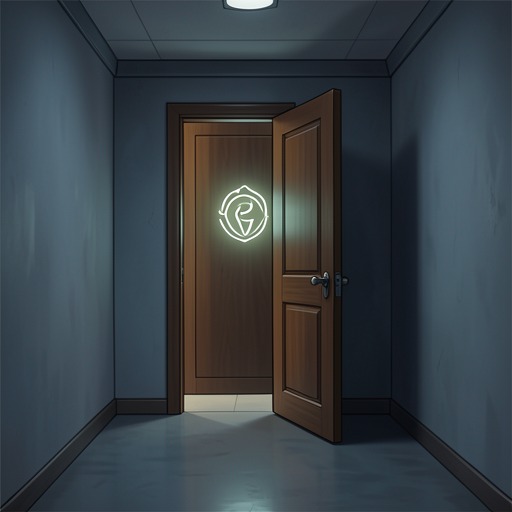
Vampires need an occupant’s invitation to enter a home
Let the Right One InVampires need an occupant’s invitation to enter a home: access depends not simply on reaching a threshold, but on someone inside explicitly permitting entry. At the Blackeberg school swimming pool, that condition becomes a tense exchange between Micke and a girl outside the glass. The scene makes permission audible and unmistakable, yet places it beside a sudden breach of reinforced glass, leaving the rule’s operation bound up with both consent and violence.
The Requirement for Permission
The rule is presented as a restriction on entry that the vampire cannot simply disregard. Its force in the scene comes from the girl’s demand that Micke speak: “Say that I can come in!” Micke does not merely open the door or passively fail to stop her. After looking back toward the pool, he nods and says, almost inaudibly, “You can come in.” The exchange makes verbal authorization the decisive act, and Micke’s gesture confirms that the permission is given even as his voice barely carries.
The girl’s insistence gives the invitation a coercive edge. She does not ask whether Micke wants her there; she demands that he say she may enter. The distinction matters: the rule requires an occupant’s permission, but the moment does not present that permission as a calm or freely chosen welcome. Micke is frightened and focused on stopping the violence in the pool. The scene therefore dramatizes the rule through a compromised choice rather than a conventional invitation between willing hosts and guests.
The Invitation at the Pool
Before Micke speaks, he is watching Jonny kneel beside the pool with a stiletto aimed toward Oskar, whose body has stopped moving. Jimmy is still holding Oskar’s head underwater. Micke has already looked toward the shower rooms, wondering why the teacher has not returned, and has withdrawn into a corner by the dark glass door. His thought is to make the assault stop, whatever the consequences. The girl’s demand arrives inside that crisis, so permission is given under pressure and in response to an immediate threat Micke does not understand.
The encounter unfolds in abrupt stages. Micke first thinks something has fallen from the roof; then something strikes the glass door hard enough to rattle its frame. Looking through the smaller pane above, he sees the girl looking up at him. When he looks back at the pool and then toward the door again, she has opened her mouth to shout, and he can see her teeth and something hanging from her arms. The delay between the first impact and this partial recognition lets the scene move from an unexplained noise to a visible, still only partly understood presence.
After Micke grants permission, the girl retreats from the door and vanishes into the darkness. The things hanging from her arms shimmer briefly before disappearing with her. The text does not describe her crossing the doorway at that moment. Instead, Micke turns back to the pool and sees Jimmy lift Oskar’s head from the water, take the stiletto from Jonny, and aim it at Oskar’s face. The invitation thus occurs while the danger inside continues; it does not immediately resolve the assault or give Micke control of the situation.
The Threshold and the Breach
The next image connects the permission exchange to a violent opening. A speck of light appears in the dark middle window, which shatters a split second later. Because the pane is reinforced, it does not break like ordinary glass: it bursts into thousands of small, rounded fragments that scatter over the pool’s edge and out into the hall. The fragments glitter briefly as they fall, turning the building’s barrier into a sudden, visible breach.
The order of events strongly associates the shattering with the girl’s access, but the scene does not spell out the mechanism. She has disappeared from the door after Micke speaks; the glass then explodes, while the text does not explicitly state that she passes through it. The episode therefore establishes the necessity of the spoken invitation more clearly than it explains the physical consequences of granting one. Permission precedes the breach, but the account leaves the precise relation between the rule and the broken window unstated.
Dramatic and Ethical Significance
The rule makes entry a matter of words, but the scene gives those words a cost. Micke’s assent is quiet and reluctant, spoken while he is trapped between the endangered Oskar and Jonny and Jimmy’s attack. His wish that the violence stop helps explain the pressure of the moment, but the narrative does not present his invitation as a deliberate bargain or show that he understands what the girl is. The threshold becomes a point where an attempt to intervene in one danger admits another presence into the enclosed space.
The scene also contrasts two kinds of helplessness. At the pool, Micke has watched the assault without acting, waiting for the teacher and shrinking into the corner. At the door, the girl forces a response from him by making him say the words that permit entry. His speech changes what can happen at the threshold, but it does not turn him into a rescuer: when he looks back, the threat to Oskar is still immediate, and the glass soon bursts. The rule is consequently more than a supernatural obstacle. In this episode it makes access depend on a human utterance, while showing how little control that utterance guarantees once given.